
Summary
Urban expansion has been a determinant of climate change. Consequently, cities around the world are strengthening their commitment to climate action through urban adaptation strategies. According to the last IPCC´s report on the impacts of global warming, urban adaptation may be accelerated by the increase in the use of natural systems for carbon sequestration. The development of green spaces, the protection of ecosystem services and water conservation can reduce significantly the risks of flooding, drought and urban heat island effects (IPCC, 2018). Integrating and promoting green urban infrastructure, such as street trees, parks, green roofs and facades into city planning may lead to an increase of urban resilience towards global warming effects in a considerably cost-effective way (Cartwright et al., 2013; Culwick and Bobbins, 2016).
These strategies have been increasingly studied in recent years by a growing scientific community, increasing as well the awareness on the key role played by Nature Based Solutions (NBS) in coping with climate change (Seddom et al., 2019). As most umbrella notions, NBS is a concept still very broad; it integrates a wide range of protection, restoration and sustainable management strategies aiming to enhance mitigation and adaptation of climate change challenges for the world’s ecosystems (Cohen-Shacham, E. et al., 2016; Nesshöver et al., 2017; Seddon et al., 2019).
NBS may be one of the best strategies for coping with climate change in Latin America. The region possesses 25% percent of the Earth’s forests and fertile land, and around 30% of the world’s water resources (Studer, 2019). Within this framework, and considering the diverse and enormous scope posed by the complete region, this research will focus in Ecuador, specifically in its capital, Quito, the country’s biggest city.
The case of Quito
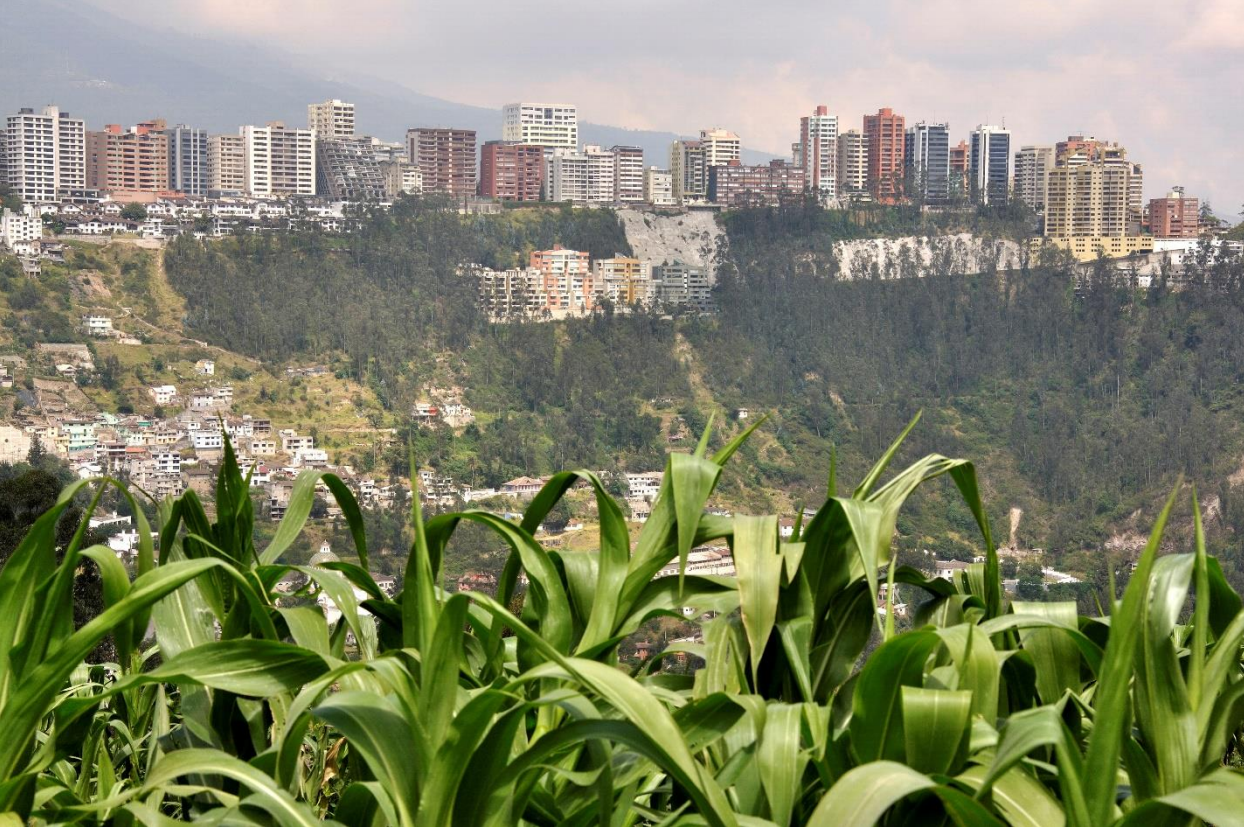
Quito is the capital of Ecuador, it has 2.7 million inhabitants (INEC, 2018), and it is the most populated and largest city in the country. The effects of climate change are evident in Quito given the decrease in water availability, major floods, biodiversity loss, landslides and urban temperature raise (Zambrano et al., 2011); these problems have been worsened by the uncontrolled urban sprawl experienced by the city in recent years, which has occupied several risks areas in the capital. Another aggravating has been the increasing use of private motor vehicles and the weak public policies to cope with it, which is causing extremely high levels of air pollution (Jurado et al., 2001). With current projections, in coming years, the city will face significant more climate threats that will impact its population, and most severely, to lower-income neighbourhoods (Carmin et al., 2012).
While the connection between Ecuador’s great diversity of natural resources and the use of Nature Based Solutions is not yet explicitly done by policimakers, nature is undoubtedly a great asset for the country. Ecuador became a pioneer in the paradigm’s change of the concept of nature, when its reformed constitution recognized the “Rights of Nature” in September 2008. Within the constitution, there are four related articles, which define Nature as “where life is reproduced and occurs” and expose a string of apparent synonyms to the meaning of nature: ecosystem, natural system, natural cycle, genetic assets, environment and natural wealth (Tanasescu, M., 2013). It also includes the rights to integral conservation and restoration, the non-introduction of genetically modified organisms and non-appropriation of environmental services (Bedón, 2017).
At a societal level, the role of nature is strongly reflected in their traditional knowledge systems and believes. Their non-anthropocentric ancestral cosmovision is named “Sumak Kawsay”, which means “good living” in the local native language (Quichua); this notion implies an interplay between the individual and collective levels of life and the harmonic relationship that should exist between human beings and “mother nature” or “Pachamama” in Quichua (Mario Melo M., 2013).
Problem statement
Nature-Based Solutions are fast becoming key instruments in the battle of urban climate change effects, not only at an environmental, but also at an economic and societal level. Since the link between knowledge creation, mitigation and adaptation action is yet to be created, this research aims to fill this gap by identifying both the available capacities and those that can be enhance, for the different stakeholders in Quito. It is critical to identify and implement cost-effective and strong mitigation and adaptation approaches to build resilience in Latin American cities for the expected climate change effects. In this way, the city could greatly benefit from this knowledge by incorporating the NBS notion in their adaptation and mitigation policies.
Research objective and questions
In that sense, the main research question for this study is: To what extend Nature Based Solutions is a suitable strategy to be implemented as a climate change adaptation strategy in Quito?
To rerspond this main question, the following sub-questions will be addressed:
- Which are the potential and realized absortive capacities of Quito’s civil society and government stakeholders?
- Which could be the drivers and barriers for implementing effective use of NBS in Quito?
- How to enhance knowledge uptake of NBS concept in Quito’s context?
- Which could be the potential benefits to introducing the new concept of NBS in Quito by designating previous actions as such?
Methodology
This research aims to use Action Research in the discipline of sustainability science. While significant knowledge has been produced on this field regarding the human-natural relation, it lacks the necessary action processes to real transit to sustainability. A solution-oriented research agenda is needed to contribute to decision-making for sustainability (Miller, 2014). According to Wittmayer and Schapke (2014), in sustainability science, the tension between descriptive-analytical and more process-oriented approaches is getting stronger. Fazey et al. (2018) explain that, in the context of climate research, to deliver highly adaptive, reflexive, collaborative and impact-oriented research, researchers need to understand that they work within a system and should become reflect on it by taking alternative roles that are more experimental and action-oriented.
Three selected cases entail the focus of this project, in order to achieve sufficient and comparable knowledge regarding the NBS and ACAP framework. Cases were selected under the cross-case method (Seawriht and Gerring, 2008), aiming to accumulate case-specific knowledge, compare and contrast cases; consequently, each case presents particular characteristics regarding their governance approaches, actors involved, scopes and aims, for what these can be defined as influential. While the concept of NBS does not appear per se in current Quito’s urban policies, numerous projects (in implementation or design phases) do fit in the criteria for NBS. Such plans recognize nature as an integral and essential element for urban sustainability; strategies such as green corridors, urban agriculture gardens, stream restoration, parks improvement were considered in the analysed cases.
Following the theoretical bases of the Action Research paradigm, this research will use an in-depth inductive approach focusing on three case studies. Data will be collected using qualitative methodology through desk research, secondary data collection and semi-structured interviews; this process will be conducted in Quito, and it is intended to take place in several cycles at different periods.
Latin American context
Despite being one of the most urbanized and biodiverse regions in the world, in Latin America and the Caribbean (LAC) there is a significantly low number of scientific publications related to urban nature and its effects on climate change. Conducted studies reflect this reality, for example, regarding urban forestry, Ordóñez-Barona et al. (2019) revealed that in the last 50 years, only 182 academic articles were found. From 13 LAC countries, from 1970 to 2018, most studies (42%) were based in Brazil, followed by Mexico (17%) and Chile (15%). Moreover, most academic publications belong only to the last decade.
Dobbs et al., (2018) in another systematic study conducted in 2017 about LAC´s research in urban ecosystem services (UES) revealed that from 22 LAC countries only five had more than ten publications on “urban ecosystem services, three countries had more than ten for “urban parks” and two countries for “urban forests” and all the LAC countries had fewer than ten publications for “green infrastructure”. This deficiency in academic production is a concerning issue, there is an urgency for reliable knowledge for LAC´s contexts such as biomes, governance and values, and scale of supplied service. Improved research funding and fostered local governance can provide upgraded strategies and the means for more effective management, planning, and equitable provision of the natural benefits (Dobbs et al., 2018) in Latin-American cities.
Tannya Pico
tannyapico@gmail.com
|
Ecuador |
| PhD on Urban Development & Governance |
| Erasmus University of Rotterdam |
|
Holanda Tutor: Alexander Jachnow |